TL;DR: if constant change excites you rather than stresses you out, and you’re willing to keep learning and trying new things, yes. Marketing is still a good career to get into in 2027.
Marketing has always been a fast-paced, ever-changing field, but in the last year or so it’s gotten especially bonkers. I’ve seen it as a marketer with 8+ years of experience: I’m often questioning everything, trying more new tools than ever, and doing things I never thought I’d even come close to, like coding.
So no wonder that people looking in (aka high school and college grads picking a new career) and even current marketers are asking if marketing is still a good career to get into now. With AI-motivated layoffs and changing customer habits, it can look scary.
Let me walk you through this question to make it less overwhelming. Use the table of contents on the side for a sneak peek or to skip ahead, and let’s just dive right in.
Will AI replace marketers?
Reddit threads and online groups are full of people sharing news about marketers or even full departments getting laid off because of AI. Is it really that serious, and will the AI era obliterate marketing as a profession?
To put it shortly: no, but it’s definitely changing it drastically.
Why marketing is still a good career
Let’s start with the positive side first so we don’t get too doom and gloom right at the start.
While AI is definitely disrupting the marketing field and even eliminating some positions, it’s not going to run itself. Someone has to write the prompts, set up the workflows, check the output, and fix things when they go wrong.
And that someone isn’t going to be the CEO. Executives want results, not hours spent fine-tuning AI agents. That work falls to marketers, and it’s something even juniors can get good at quickly.
Beyond running the AI, there are also parts of the job it still struggles with, and likely will for a long time:
- True creativity: AI is great at producing more, but its default output is the average of everything it has seen. Ideas that make people stop scrolling usually come from breaking the pattern, and in a feed full of AI content, standing out is worth more than ever.
- Hands-on content creation: while even AI-generated videos are better than ever, people are also craving real connections more, so we’ll need real marketers to make content with real products and people. AI simply cannot step out of the screen to do that.
- Strategy: AI can tell you how to run a campaign, but not which one is worth running. It doesn’t know your margins, your history or your customers, and someone still has to own the decision.
- Distribution: Making content is almost free now, but getting the right people to see it isn’t. Building communities, partnerships, and trust on platforms that push back against AI spam takes human judgment.
- …and the very human-centered aspects, like client relationships: people still buy from people, especially the ones they trust. No matter how sophisticated, AI can’t read nonverbal cues, handle tense calls, or read a room like a real human can.
So if you’re someone who thrives on creativity, new ideas, connection with people, telling stories, and making big ideas come to life, marketing is still very much an amazing career to choose. You just need to be ready for a bit of a rollercoaster ride.
There’s also plenty you can do to keep up and adapt, to future-proof your marketing career and show your value to clients and leadership. Scroll a little further for specific tips on that.
Why it might be a bad choice for some people
While all of that is true, so is the fact that marketing jobs are getting cut as companies are trying to save money by automating things with AI, as they’re tempted to choose “cheap and good enough” over the quality that a full team of marketers could bring.
This of course looks different depending on the size of the brand: big firms are replacing multiple people or even full teams with AI managers, while small businesses are trying to use AI themselves.
Which marketing roles are most at risk?
Typically, it’s the entry-level, execution-only jobs that are the most at risk of being replaced by AI. These are usually simple, singular tasks like writing an email based on a template, doing on-page SEO optimization based on given guidelines, or similar things that can easily be prompted and automated.
This is of course pretty problematic, as if this would make it impossible to get into the field, it’d completely break the career ladder when now-senior marketers start retiring in a couple of decades.
And that’s why getting your foot in the door, and future-proofing your skills and career (see the next section) is more important than ever.
Are specialists more at risk than marketing generalists?
Another, less talked-about group is highly specialized roles.
This might be controversial, as there are people who say it’s generalists who should pivot, but in my experience, being super specialized in one area of marketing is the professional version of putting all your eggs in one basket.
We’ve seen AI improving, conquering areas it couldn’t cover before. Your niche might feel safe now, but you never know when you get in the line of fire as well.
But if you’re a jack of all trades, or at least pretty good at multiple areas of marketing, ready to experiment and learn new things, you’ll be a real asset for your company.

There are of course people who disagree: this redditor argues for specialization
I know that wearing an endless number of hats is the bane of marketers’ existence (it is mine too), but with these recent changes, I really think this is the way to go. Just to show you a personal example:
- I’m a content marketer and writer at heart, who specialized in SEO and organic content marketing.
- I first dipped my toes into graphic design and video content creation, doing it all end-to-end: concepting, scriptwriting, filming, editing, designing, etc.
- Then I also tried paid advertisements on Pinterest and YouTube. I knew the theory thanks to my experience with marketing strategy, so I didn’t shy away from the execution either.
- And of course, as a product marketer, I couldn’t avoid vibe coding either. Now I’m creating landing pages, debugging ad tracking, and even adding new features to our SaaS product when I need them for a marketing activity.
This is the kind of flexibility I mean, which can be invaluable, especially if you work for a startup or small business.
How to future-proof your marketing career
This is the part where we stop spiraling and take action instead. Here are 4 things you can do to prove to both your boss and yourself that you’re better than an AI agent and cannot be replaced.
Know the customer better than AI can
Sure, you can feed AI your customer persona, or if you’re pro, even research materials and interview scripts. But it still doesn’t understand non-verbal cues during a user test, implications, and things that can only be read between the lines.
AI doesn’t have the ever-changing cultural context and things that impact your ideal customers day by day. But you can. If you know where to look, how to reach and talk to them, you can get a way better understanding, which essentially is the base you need for good marketing.
If you build on that and can show and explain what makes your business different, why they need your product or service, you win the game, AI or no.

Make reporting that ties your work to revenue
This tip is for marketers already in the business.
Even if you’re on the creative side of marketing, at the end of the day, it’s a field of numbers where every activity has one purpose: to drive business results. And if you can prove that what you do ties in to those numbers directly, your position will be much more secure.
Let’s say you work in social media marketing. If your reports have been about mostly vanity metrics like followers or even engagement rates, it’s time to go deeper and switch it up. Dig into the tracking (or if it’s not there, set it up asap) and see what happens with the people you activated.
How much traffic is coming from social media? What do those people then do on the company’s website? Can you attribute specific sales and order value to people that came from your posts or campaigns?
Because while CEOs say they understand and accept brand awareness efforts, they’ll always secretly be hoping for quantifiable sales tied to those social media efforts.
Use AI instead of fighting it
What I found, and a lot of marketers also concluded online, is that one of the best things you can do is to use AI instead of fighting it. It can be tricky if you’re personally not a big fan of AI and its impact on our environment and intellect (hi, we’re in the same boat then), but unfortunately it seems to be kind of inevitable.
One way AI tools can open doors for you is by letting you pick up skills (or rather capabilities) that used to be simply out of reach before. I always envied motion designers who could make beautiful animations, and developers who could make ideas actually come to life as working products.
Now, even as a marketer, I get to do all of those things. I can make animations with Claude or Remotion, and build products or tweak code with Arca.
So think about what you’ve often wished you were able to do, and see if there’s a good-enough AI solution for that, so you can extend your marketing skills a little.
The other way is to build automations and ops systems that make your work and life a little easier. This works great for repetitive tasks with enough context, and it’s what people mean when saying that AI can make us faster and more efficient.

Get good at channels that depend on trust
Lastly, double down on what AI can’t fake: trust.
Now that anyone can churn out endless content for free, people have become more skeptical of everything in their feed. They want to read, watch, and buy from people and communities they already know, which makes channels built on real relationships more valuable than ever:
Community building
Groups like Slack communities, Discord servers, subreddits, or customer forums run on real conversations, and members can spot a bot or a sales pitch right away. Many online communities now actively ban AI-generated promotions, so marketers who can start conversations and give genuine value are hard to replace.
Creator partnerships
Audiences trust creators they’ve followed for years far more than brand ads. Finding the right creators and building relationships with them is a people skill, and one in demand: the AMA lists influencer marketing as the fastest-growing marketing job.
Founder- and employee-led content
We’re back to the fact that people trust people more than logos. So no wonder that posts from a founder or team members often outperform the company page, especially on LinkedIn...
And marketers who help colleagues find their voice, convince them to actually appear in content, and post consistently (without making it sound written by AI) are hard to replace.
Events
Meetups, workshops, conferences, and webinars give people something AI can’t: being in the room together. Planning them, getting the right people there, and following up afterward is very human work, and face-to-face relationships often lead to the biggest deals.
How to use AI to get ahead
It’s easy to say “use AI to your advantage instead of being afraid of getting replaced”. But with sooo many different options, this can sound very overwhelming. To make it feel like a no-brainer instead, here are 5 specific ways to use AI to get ahead in your marketing career.
These all come either from my personal experience as a content/product marketer of 8+ years, or are ones that are on my own list to do asap.
Vibe-code landing pages and product features
Have you ever been in the situation where you needed a new landing page for a marketing campaign, but had to wait for a designer and developer to make it for you?
This is often the case when a brand custom-codes their pages, or uses a website builder that’s very far from intuitive to use. Well, with AI and vibe coding tools, you can both design and develop the landing pages you need, so no more waiting for others to launch your campaigns.
And if you’re a marketer working with a SaaS product, you could take it one step further and fix bugs or add new features too.
It’s happened to me that I was trying to make a screen recording for marketing materials, but a bug was just so hard to get around, it was driving me insane. I don’t want to sound like a teleshopping commercial, but now I can just easily fix it for myself and get on with my recording.
We did need a session with our developer at the beginning to set up Arca for us, and then to check and publish our changes (commits and PRs for those who have done it), but it’s been smooth sailing (and unexpectedly a lot of fun) since then.

My own LinkedIn post about shipping the first feature I developed using AI
Make animations and visuals
I’ve always been great at writing, decent at graphics, but totally clueless when it comes to animations. One of the “superpowers” AI has given me as a marketer is animation.
Even just Claude has gotten surprisingly good at creating animations for social media posts or landing pages. It obviously needs to know your visual branding very well, and you need to be detailed with your prompts, going back in to remove the AI-giveaway details.
Pro tip: create a few frames to guide the animation
Purely prompt-based animation can still be tricky, so if you want to get the details right, try to create a few frames as the overall structure of your animation. Give these then to your chosen AI, and tell it to create the animation, following a specific order.
But there are even dedicated tools, yet again, if you’re working on a digital product, that can take components of your product’s codebase and create animations using those. This means you won’t have to dig through Figma to find the parts and create frames, but can just prompt your way through the whole thing.
We’re using Remotion for this purpose.
Do data analysis in less time
If visuals and animations have always been your strong suit, but spreadsheets make you wanna scream, this one’s for you. Because even if you have no idea what’s going on or what formulas you’re supposed to be using, you can now make sense of large amounts of data with AI.
The caveat here: you need to know what you want to get out of the data and be able to formulate that question very specifically. It helps if you give your chosen LLM context and as much information as possible, and try to avoid just saying “here’s my data, analyse it and tell me your conclusions”.
And if you’re doing data analysis with AI for a report to present to your managers, always make sure to double-check the numbers and statements at the end, to make sure your AI didn’t just hallucinate something for you.

Repurpose long content
The expectation with AI in marketing is to have more output in the same amount of time, and repurposing long-form content is one way you can do that.
If you’ve done a webinar for example, you can use a tool like Descript to easily create shorter clips from it that you can then post on social media.
You can also transcribe the webinar (or a long-form YouTube video) and turn it into an SEO-optimized blog post. Want to stretch it even further? Break up that blog post into shorter pieces for LinkedIn posts.
Whatever long-form content you have, you can always repurpose it by either changing the format (creating visuals or videos out of text, or the other way around) or breaking it up to smaller pieces, now much faster with AI.
Document your AI workflows as portfolio pieces
Okay, this last one is technically not using AI to do work for you, but documenting your usage of it for your marketing portfolio. (Pssst, with a portfolio builder like Copyfolio, adding a page for it is one click, and filling it out will be less than 10 minutes.
AI skills, being up-to-date with the latest tech, and the ability to use AI tools is popping up in most of the marketing job posts these days. And if you want an advantage over the applicants who just add a line about them in their CV, you can dedicate a project page to how you get more productive with AI.
You can break it up by tools, write about your usage, and add a few examples of things you’ve created with them. Or you can explain your different workflows, highlighting how new AI tools now fit into them and how they changed your work and outputs.

Marketing jobs and which one’s the best for you
Marketing jobs can be so wildly different that hearing about one could turn you away, even if another would be a perfect fit. So here are a few different marketing positions to consider, each with a little description to show you which one could be a good fit.
Content marketing or copywriting
If you love writing and creating things, these avenues would be perfect for you.
Copywriters tend to write shorter, snappier copy like conversion copy for landing pages, while content marketers usually opt for longer pieces like blog posts.
Content marketing can also include other formats as well, so if you’re intrigued about creating videos and more, you’d really enjoy this specialization.
Email marketing or marketing ops
If you’re an organized person who loves a good spreadsheet, marketing ops or email marketing is the way to go for you.
In marketing ops, you’re the one who connects people, data, processes, and technology, so while you need to understand the areas of marketing, you also need to see the big picture and keep on top of everything.
Email marketing involves a little less data and a little more creativity. You still need to be able to analyze the performance numbers and build complex automation workflows, but you also get to write and design emails, which can be a lot of fun.
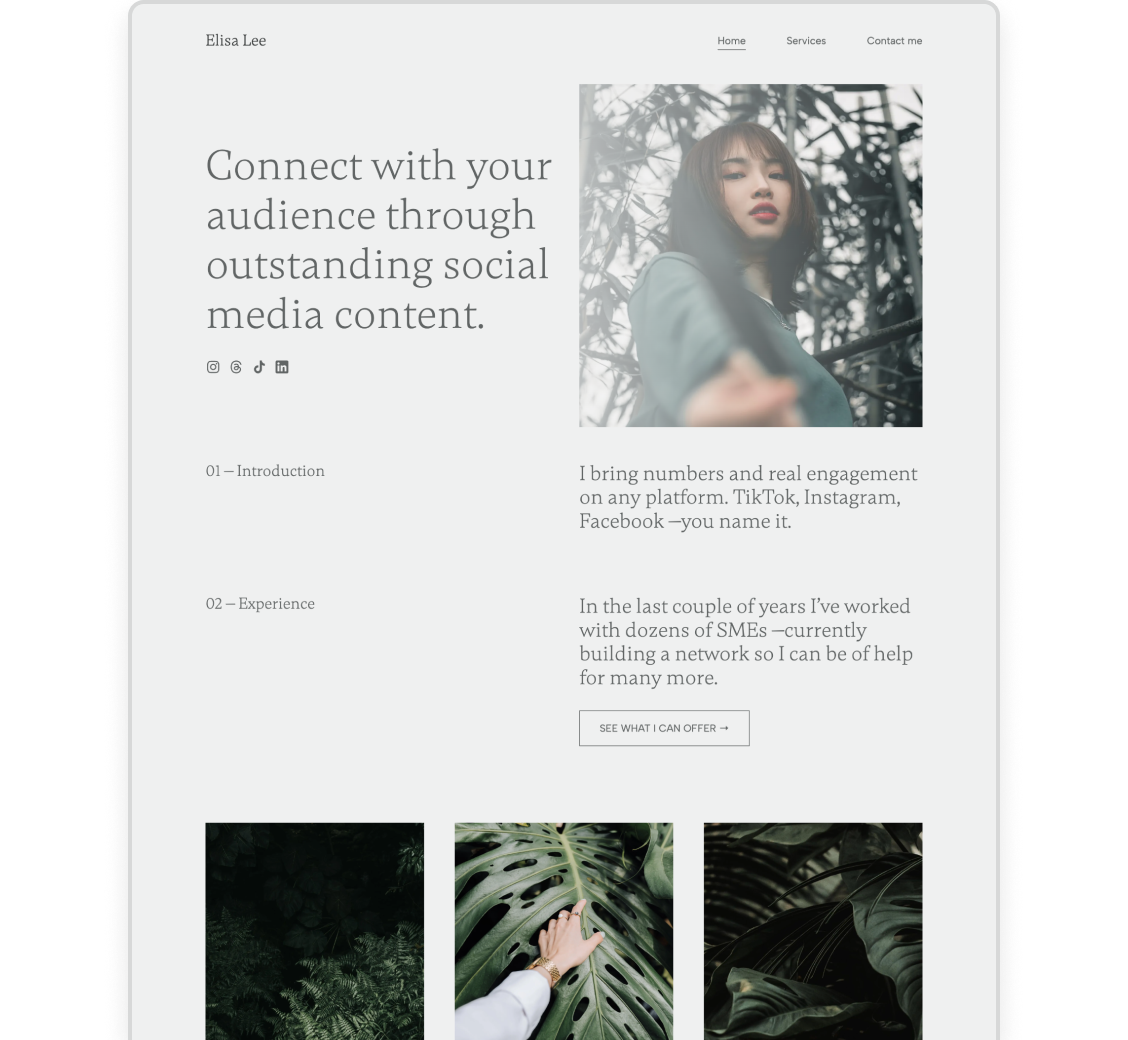
Social media marketing or community management
Are you an extroverted people-person who’s chronically online? If you’re nodding and saying “oh yes” then you should check SMM or community management.
Social media marketing doesn’t need an introduction: she’s the cool girl most marketers covet these days. But it’s not as easy as it once was:
- trends change faster than ever and you need to keep up,
- video rules so you need to be able to script, film, and edit,
- speaking of video, there’s a good chance you need to be on camera too
- it often involves knowing not just a bunch of platforms, but all their different ad managers too
If that sounds a little too intimidating, but you still want to connect with people online as your job, community management could be a great choice. With AI slop everywhere, people are seeking real human interaction, and brands need marketers who can utilize that within their own audience.
Growth or performance marketing
If you’re analytical, love figuring out what works, and don’t mind experimenting and trying out new things, you’ll looove growth marketing (or performance marketing).
The main goal here is exactly as the title says: make your brand or product grow. The twist here is that your tasks or main responsibilities are not necessarily given, as if you were an email marketer, for example.
Here there’s a good chance that you’re going to be figuring out the strategy, the channels to use, and executing your ideas as well. You might try out a bunch of different things, half of which you’ll abandon as they’re not living up to your expectations.
For this marketing position, you need to be ambitious and flexible, and not afraid of dipping your toes into many different areas of marketing. But the good news is that you’ll never be bored, and these jobs are usually pretty well paid too.
Brand marketing or PR
You need to be an outstanding storyteller first and foremost to excel in either brand marketing or PR.
In both positions, you hold the overall image and reputation of your brand in your hands, and navigate the online space (mostly) so that it’s as beneficial for you as possible.
They’re definitely pretty creative fields of marketing communications, but they both also need a strong affinity for strategy too.
You also need to be able to find good opportunities for your brand, even if they’re not easily presenting themselves, and you can’t be afraid to reach out to others to build connections.
Digital paid advertising
If you’re competitive and love a challenge, you might enjoy digital paid advertising, aka being a PPC specialist.
For this, you also need to be able to work with numbers, create reports that translate those numbers into easily explained business results, and also work with creatives at the same time. Not to mention, you gotta be comfortable with working with (aka spending) money, even if it sometimes goes for experimentation.
But the good thing about this field is that with the right tracking setup, everything here is very nicely attributable. You know how the social media girlies are fighting for their life trying to convince their CEOs about the benefits of brand awareness?
You won’t have to deal with that, as you’ll be the one with the clearest ROI numbers at the table.
So if you like numbers and don’t mind learning the ins and outs of different ads managers, paid advertising is the way for you.
Getting your foot in the door is harder than ever, since AI now handles a lot of the tasks juniors used to start with, so be ready to do whatever it takes to get that first role. The good news is that in marketing, what you can show usually matters more than your diploma. Here’s how to get there:
- Learn for free. Free online courses (Google, HubSpot and Meta all offer free certifications), YouTube tutorials, and even TikTok and LinkedIn creators can teach you the basics. Start with one area you enjoy, like social media, email or paid ads, then branch out once you’ve got the basics down.
- Build a portfolio with mock projects. No clients yet? Make some up. Create a social media campaign for your favorite brand, rewrite a local café’s website, or build a landing page with AI. Explain your thinking behind each piece, not just the result. Collect these in an online portfolio, Copyfolio has templates specifically for marketers that’ll make it really easy.
- Get real experience through a few free projects. Offer to help a friend’s small business, a local nonprofit or a student organization. Even one project with real results (more followers, more signups, more sales) is worth more than ten certificates.
- Follow the typical path. Most marketers start with an internship, move into a full-time junior role, then grow into a mid-level position within a few years. Don’t worry too much about the perfect first job. Getting in is what counts, and you’ll pick up more skills along the way.

So, is marketing a good career for you?
If you’re ready to keep learning and trying new things, then marketing is still a good career to choose. Be aware that getting in as a career starter is a little bit harder these days, but with a strong marketing portfolio, it’s definitely not impossible.
Check the rest of our blog for more career tips, and try Copyfolio to build your portfolio website in less than an hour today.